Largest Contentful Paint (LCP)
LoadingMeasures when the largest piece of content in view, usually a banner photo or the main heading, is fully drawn. Google wants it within 2.5 seconds. Oversized photos are the usual cause.

Speed Optimization
Lighter, quicker pages for Kingston business websites, tuned for the visit that matters most: a first look on a phone, by someone deciding between you and the next result.

Many Kingston searches carry a sense of urgency: “kingston walk in clinic wait times”, “pizza kingston open now”, “wolfe island ferry schedule today”. The person typing is on a phone, often outdoors, and wants one fact: hours, a menu, a time, a price. If your page takes long enough to load that they notice the wait, the back button is easier than patience.
Students between lectures, visitors on the waterfront and residents in the rural north of the city all open your pages on whatever connection they have. You cannot control their network, but you can control how much your page asks it to carry: the size of each photo, the number of scripts, and how quickly your server starts to answer.
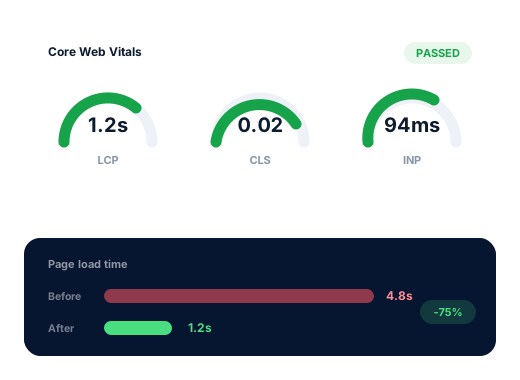
Google is watching too. Its Core Web Vitals report, built from real Chrome visits, scores how soon the main content appears, how fast the page reacts to a tap and how much the layout jumps around. These are one ranking factor among many, but a site that passes them also tends to hold on to more of the people who arrive.
Search demand
Google.ca suggestions from October 2026. Nobody searches for site speed with “Kingston” attached, but these show the hurried, phone-in-hand visits where a slow page loses the customer.
Not every page deserves equal effort. On most Kingston business sites a handful of pages do the heavy lifting: the menu, the hours and location page, the booking form, the price list. We find them in your analytics and make them quick first. The target is a pass in Google’s field data, not a perfect lab score.
Usual suspects
It is rare to find just one of these; they tend to travel together.
Waterfront views, patio shots and before-and-after renovation photos are often uploaded at full camera size, then squeezed into a small box on screen. Sizing each photo to its slot and saving it as WebP usually removes most of the weight with no visible change.
Restaurants, tour operators and salons often post the one thing customers want as a PDF or a photo of a printed sheet. On a phone that means a large download, pinching and zooming, and text Google struggles to read. A simple HTML version fixes all three.
Visual page builders bundle the code for every possible layout and load much of it everywhere, even on a short contact page. Replacing the builder is not always necessary; trimming what it loads usually is.
A chat bubble from one campaign, a review carousel from another, three tracking tags and a social feed. Each seemed small when it went in; together they can keep a phone busy for seconds after the page appears.
Budget shared hosting can pause for a long moment before sending the first byte. Caching hides some of that, but if the server itself is the bottleneck we show you the numbers and let you decide whether to move.
What Google measures
Each score comes from real visitors using Chrome, pooled over a rolling four-week window. To pass, a page needs three out of four of those visits to hit the target on every measure.
Measures when the largest piece of content in view, usually a banner photo or the main heading, is fully drawn. Google wants it within 2.5 seconds. Oversized photos are the usual cause.
Times the gap between a tap or click and the screen visibly reacting, across the whole visit. The goal is 200 milliseconds or less. Third-party extras such as chat windows, booking widgets and piles of tracking tags are the usual drag.
Adds up how far things jump while the page loads, which is why people tap the wrong button. A score below 0.1 passes. Giving images, banners and embedded maps a reserved space before they arrive fixes most of it.
The work
We capture lab tests and any available real-visitor data for your most-used pages first, so you can compare like with like at the end.
Responsive image sizes so a phone downloads a phone-sized picture, modern formats, and lazy loading for anything below the first screen.
PDF menus, timetables and price lists rebuilt as plain HTML that loads quickly and that search engines can read.
An audit of every script on the page: what is unused goes, what must stay waits until the visible content is ready.
Page caching, browser caching and, where it helps, a content delivery network, set up to match what your hosting plan supports.
Quick lab checks on launch day, then a return visit after Google’s four-week data window has refreshed, so the result you see is the one Google sees.
Done carefully
The standards we hold ourselves to on every account, set down in writing.
Speed removes a reason to leave. On its own, it does not give anyone a reason to choose you.
Google treats page experience as one of many signals, so we never sell speed as a ranking shortcut. What it reliably does is keep impatient visitors on the page. The project itself is priced once, after we have audited the site.
Ask us about your business
How we work
Four stages, in the same order for every Kingston client, whatever the trade.
We audit your site and Business Profile and check your positions from downtown, the west end and the towns you serve.
We pick the Kingston searches most likely to bring work and match each one to a single page.
Profile, website, content and listings are improved in order of likely payoff, timed around your busy season.
You receive a one-page summary of the month’s calls, enquiries and rankings, plus the jobs lined up next.
Questions
Open PageSpeed Insights, enter your home page and look at the mobile results. The top section, drawn from real visitors, matters most; if it is empty, use the lab figures below. Then try the site on your own phone with Wi-Fi switched off.
Google draws the line for you. Passing means the biggest element on screen is drawn inside 2.5 seconds, taps get a visible response inside 200 milliseconds, and layout shift stays below 0.1, all measured on real visits. Past those marks, extra effort rarely changes what customers experience.
Occasionally, as a tie-breaker between two otherwise equal businesses. The dependable gain is in visitor behaviour, since fewer people give up while the page is still loading.
In most cases. Opening a PDF on a phone means a download, then pinching and scrolling, and search engines get little from it. Rebuilt as an ordinary page, the same menu appears faster, reads comfortably and takes a minute to edit when a price changes.
The changes themselves often take one to two weeks on a small business site. Google’s field data then needs its four-week window to catch up, so the official pass shows roughly a month later.
It is a one-time quote in Canadian dollars, given after an audit, because the causes vary from site to site. Once the site is fast, keeping it that way is part of routine upkeep in our monthly plans at $250, $350 or $550.
Further reading
More on this topic for business owners in Kingston, Ontario.
Any of these can be hired on its own; many clients begin with just one.
Customers look for each of these in their own way, so every page is researched separately.
A free audit shows how you rank from downtown to the west end, who sits ahead of you and which fixes will count most.
Request my free audit